7 Mental Frameworks for SaaS Success: Building the Right Mindset for Founders

The founders who win don't work harder—they think differently. Learn the 7 mental frameworks that successful SaaS founders use to make faster, better decisions.
7 Mental Frameworks for SaaS Success: Building the Right Mindset for Founders
See also: Customer Obsession Guide | Sales Mentality for Technical Founders | MVP & Launch Strategy
Introduction
The difference between successful SaaS founders and those who struggle often isn't talent, funding, or even timing. It's the mental frameworks they use to approach problems.
I've watched hundreds of founders build companies, and I've noticed something: the ones who win don't just work harder—they think differently. They use mental models that help them cut through noise, make faster decisions, and stay resilient when things fall apart (because they always do).
These seven frameworks have become the foundation of how successful SaaS founders operate. Master them, and you'll have a competitive advantage that money alone can't buy.
1. The First Principles Framework: Question Everything You Assume
Why it matters: Most founders spend their first year solving problems that don't actually exist.
Elon Musk popularized the concept of first principles thinking—breaking complex problems down to their fundamental truths and rebuilding from scratch. For SaaS founders, this is a lifeline.
How it works:
The typical founder reads an article about "what SaaS companies need," builds ten features they think customers want, and then discovers nobody actually asked for them. Instead, first principles thinking asks:
- What specific problem are we solving? (Not "we're building a CRM"—why does someone need it?)
- What do customers actually need to solve it? (Not what the market says they need—what do your customers need?)
- What's the minimum viable solution? (Not the minimum product—the minimum solution.)
Practical application:
When you're tempted to add a feature, ask: "What customer problem does this solve? Can I prove it?" If you can't articulate it clearly in one sentence, it's probably not a first principles solution—it's a feature you think sounds good.
This connects directly to your MVP strategy. See our guide on MVP & Launch Strategy to understand how first principles thinking shapes your product roadmap.
Real example:
Stripe started by asking: "Why is accepting payments so hard?" The real answer wasn't technical—most payment processors built for large enterprises. Stripe's insight: developers wanted to integrate payments in minutes, not weeks. That first principle shaped everything from API design to documentation.
2. The Optionality Framework: Keep Multiple Paths Open
Why it matters: Founders who commit too early to one direction often run out of runway before they find product-market fit.
This framework comes from naval strategy and options theory. The idea: it's better to have multiple paths forward than to win spectacularly on one bet that might not work.
How it works:
Most founders build a product, launch it, and if it doesn't work, they're out of options. Instead, the optionality framework asks: "How can I keep three different paths alive simultaneously?"
- Keep your burn rate low (which extends your runway and buys you optionality)
- Avoid technical decisions that lock you into one direction
- Talk to multiple market segments and build for the one with the clearest need
- Build partnerships instead of betting everything on organic growth
Practical application:
If you're running a B2B SaaS company, you might initially talk to:
- Large enterprises (high ACV, long sales cycles, lots of customization)
- Mid-market companies (balanced needs and sales cycle)
- Small business owners (self-serve, low ACV, but faster validation)
Most founders force themselves into one path too early. The optionality framework says: keep all three paths viable until you have clear evidence of where the real opportunity is.
This ties directly to customer obsession. See our Customer Obsession Guide to understand how talking to multiple segments keeps options open while revealing genuine customer needs.
Real example:
Slack didn't start as a communication platform for companies—it grew out of an internal tool. The team kept multiple paths open: they could have been a gaming company, a productivity tool, or an enterprise communication platform. By staying optionable, they discovered their real market.
3. The Systems Over Goals Framework: Optimize for Compounding
Why it matters: Founders fixate on vanity metrics. Systems thinking prevents that.
A goal is an outcome. A system is a process that leads to outcomes. Systems compound; goals plateau.
Most founders set revenue goals and then wonder why they never hit them. The systems framework asks: "What system needs to exist for that revenue to be inevitable?"
How it works:
Instead of "We need $10K MRR by December," ask:
- What system gets customers to find us?
- What system turns interested people into paying customers?
- What system keeps customers happy and reduces churn?
- What system generates word-of-mouth referrals?
Practical application:
Let's say you want $10K MRR by December. Here's the systems approach:
- Discovery system: You need customers to know you exist. What channels drive this? (Content, ads, partnerships, word-of-mouth?)
- Conversion system: You need 20% of people who discover you to become paying customers. What's your onboarding, pricing, and value proposition that makes this happen?
- Retention system: You need customers to stay for 12+ months. What's your success metric for them? How do you measure and improve it?
- Referral system: You need existing customers to bring new ones. What makes your product worth recommending?
Every one of these is a system you need to design, test, and iterate. Goals are the output; systems are what you control.
This directly relates to your sales mentality. See our guide on Sales Mentality for Technical Founders to understand how to build the systems that drive sustainable customer acquisition.
Real example:
HubSpot's flywheel isn't a goal—it's a system. Customers use the free CRM, they see value, they upgrade to paid, they get more value, they refer others. That system compounds. By optimizing the system, they hit their revenue goals naturally.
4. The Constraints Framework: Scarcity Breeds Creativity
Why it matters: Unlimited resources lead to bad product decisions. Constraints force you to solve the real problem.
This framework comes from design and creative fields. When you have $10 million in funding, you can build ten features and hope one sticks. When you have $100K, you build one feature and obsess over it.
Interestingly, constraints usually win.
How it works:
Constraints in SaaS typically look like:
- Limited engineering time → Force prioritization
- Limited budget → Force focus on highest-impact channels
- Limited market → Force deep understanding of customer needs
- Limited time before runway runs out → Force speed
These constraints aren't obstacles; they're clarity. They eliminate the possibility of doing everything.
Practical application:
When you're deciding what to build next, don't ask "What would be nice to have?" Ask "What's the one thing that, if we don't build it, we won't hit our metric?"
If you're deciding how to acquire customers, don't ask "What channels should we be on?" Ask "Given our budget, which one channel gets us to profitability fastest?"
Constraints force trade-offs. Trade-offs force focus. Focus wins.
Real example:
The early days of Superhuman (a fast email client) were defined by extreme constraint. They built for a single persona with a specific problem: "Reading email takes too long." Every feature was evaluated against that constraint. The result: a product that obsessed 15,000 power users instead of a mediocre product for 100,000 casual users.
5. The Learning Framework: Validate Assumptions, Not Dreams
Why it matters: Founders operate on assumptions they never test.
Every business plan is a list of assumptions: "Customers will pay $100/month." "Enterprise sales cycles are 4 months." "We'll reach profitability in 18 months." Most of these are wrong.
The learning framework treats every assumption as testable.
How it works:
For each assumption in your business, ask:
- How would I know if this is true?
- What's the cost of being wrong?
- When should I validate this?
Some assumptions are low-cost to validate (customer willingness to pay). Others are expensive (enterprise sales cycle). Some are worth validating early (whether people care about your problem). Others can wait (optimal pricing).
Practical application:
Create an assumption map:
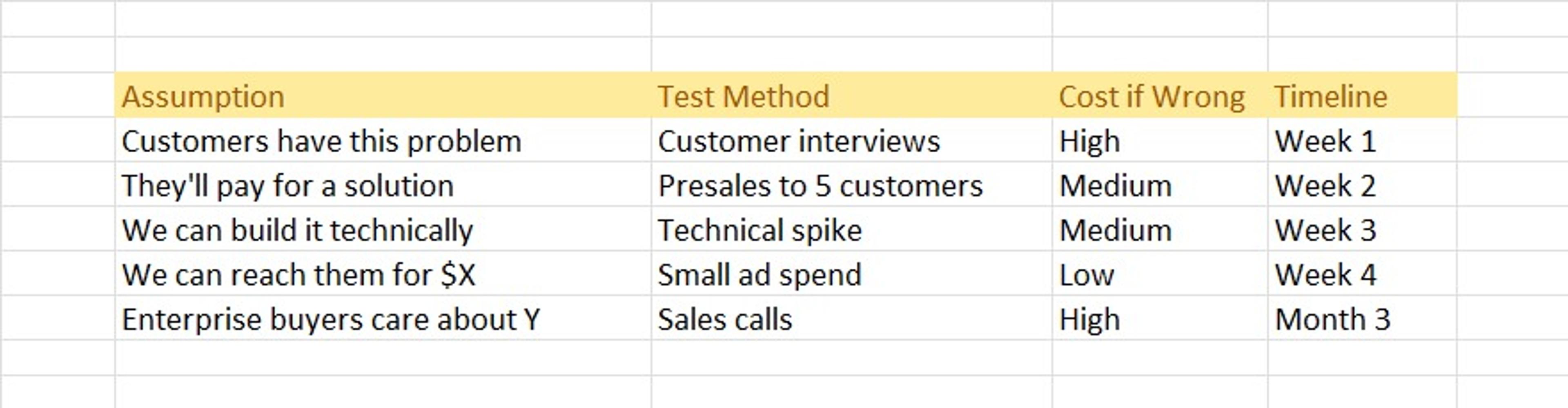
Test high-cost assumptions early. Test low-cost assumptions as you go. This prevents building a product nobody wants and keeps your learning cycle tight.
This is fundamental to building a solid MVP. See our MVP & Launch Strategy guide to understand how to validate assumptions in your MVP design.
Real example:
Airbnb founders did this obsessively. Instead of building a perfect platform first, they tested assumptions by manually managing listings, going to customer homes, and understanding the trust dynamics. Each validated assumption shaped the next iteration.
6. The Antifragility Framework: Design for Optionality Under Stress
Why it matters: It's not about surviving bad times—it's about thriving because of them.
Taleb's concept of antifragility goes beyond resilience. Resilient systems bounce back to normal. Antifragile systems benefit from shocks.
How it works:
Most founders think about risk as something to minimize. Antifragility asks: "How can uncertainty make us stronger?"
Some examples:
- Diversified revenue: If one customer type disappears, you lose 20%, not everything
- Open-source community: If your SaaS fails, your open-source project grows
- Flexible pricing: If the market shifts, you adapt faster than competitors with rigid pricing
- Technical optionality: If AWS gets expensive, you can move to Azure without rewriting everything
Practical application:
When you're designing your product, your sales strategy, and your business model, ask: "What uncertainty could actually help us?"
If you're dependent on one customer for 50% of revenue, that's fragile. Create diversification. If your entire product is a monolith, that's fragile. Build modular systems. If you're locked into one go-to-market motion, that's fragile. Keep multiple channels active.
This connects directly to your customer obsession work. See our Customer Obsession Guide to understand how deep customer knowledge creates antifragility by revealing non-obvious opportunities.
Real example:
Basecamp (formerly 37signals) benefited from the recession in 2008. When companies cut budgets, they didn't need bloated software—they needed simple, affordable tools. Basecamp thrived because the market shock strengthened their core thesis.
7. The Narrative Framework: Become a Storyteller, Not Just a Founder
Why it matters: The founder who tells the best story wins, even if the product is equal.
This isn't about manipulation. It's about clarity. Companies that win have a narrative: why they exist, why now, why they're different.
How it works:
Great founding narratives have four elements:
- The Problem: Paint a picture of the world without your solution. Make it real.
- Why Now: Why is this solvable now that it wasn't before? (New technology? Market shift? Changed behavior?)
- Your Insight: What did you see that others missed?
- Why You: Why are you the person to solve this?
Practical application:
Test your narrative. Can you tell it in two minutes and have someone understand not just what you do but why it matters?
Strong narrative examples:
- "Sending files over email is broken. Most files are too big, you can't track versions, and security is a nightmare. We made a tool that integrates with your existing email but handles everything email can't." (Dropbox)
- "Spreadsheets were built for accountants. We built a database that non-technical people can actually use." (Airtable)
Your narrative becomes your recruiting story, your investor pitch, your marketing, and your customer value prop. Get this right, and everything else becomes easier.
This is essential to your go-to-market strategy. See how narrative shapes your launch in the MVP & Launch Strategy guide.
How These Frameworks Work Together
Notice how these aren't independent ideas:
- First Principles helps you identify the real problem
- Optionality keeps you flexible as you validate
- Systems ensure your solution compounds
- Constraints keep you focused on what matters
- Learning prevents expensive mistakes
- Antifragility ensures you survive
- Narrative makes everything resonant
Master these seven, and you'll make better decisions faster than competitors who are just grinding.
What's Next?
Now that you understand the mental frameworks that drive decision-making, it's time to apply them to your product and customer. We recommend exploring these related topics in order:
- Customer Obsession Guide: How to apply the Learning and First Principles frameworks to understand what your customers actually need
- Sales Mentality for Technical Founders: How Systems and Narrative frameworks shape how you acquire and retain customers
- MVP & Launch Strategy: How all these frameworks converge to create a focused, testable launch
Key Takeaways
- First Principles: Question every assumption about your product and market
- Optionality: Keep multiple paths viable until evidence emerges
- Systems Over Goals: Build processes that compound rather than chase metrics
- Constraints: Use limitations as creative clarity, not obstacles
- Learning: Treat your business plan as a list of testable hypotheses
- Antifragility: Design for uncertainty to become stronger
- Narrative: Tell a story that makes your mission unmistakable
The founders who win aren't the smartest or the luckiest. They're the ones who think differently.
Have a framework that changed how you build? Share it in the comments below.
Related Resources:
- Customer Obsession Guide — Apply these frameworks to customer research
- Sales Mentality for Technical Founders — How technical founders can develop sales acumen
- MVP & Launch Strategy — Design your launch around validated assumptions
About the writer

Founder & Writer · EveryTuesdays
You May Also Like
Browse All
No-Code + AI: How Indie Hackers Are Building Apps With Bubble, Lovable & GPT in 2026
AI has supercharged no-code. Discover how indie hackers are combining Bubble, Lovable, and GPT-4 to build smarter apps faster and the tools making it possible in 2026.
How to Monetize a No-Code App: Pricing, Payments & Getting to $1K MRR
Built your no-code app now make it profitable. The complete monetization guide for indie hackers: pricing models, Stripe setup, conversion tactics, and reaching $1K MRR.
How to Validate a No-Code App Idea Before Building Anything (The 2-Week Method)
Stop building apps nobody wants. This 2-week validation method helps indie hackers confirm real demand, find paying customers, and avoid the #1 no-code startup mistake.