Conscious Spending Over Frugality: How to Spend Extravagantly on Joy and Cut Mercilessly on Junk

Stop saving pennies and start designing a life of intentional extravagance. Learn why blanket frugality fails and how to spend guilt-free on what you love.
For decades, the personal finance industry has been obsessed with a singular, restrictive narrative: the gospel of 'No.' We are told that the path to wealth is paved with the corpses of unbought lattes, cancelled Netflix subscriptions, and the perpetual avoidance of anything that might bring a momentary spark of pleasure. This traditional approach to frugality is built on a foundation of scarcity, suggesting that every dollar spent is a dollar lost to the abyss. But this philosophy is fundamentally flawed because it ignores the most critical variable in the wealth equation: human psychology. When we treat our finances like a permanent crash diet, we inevitably succumb to the financial equivalent of a binge-eat, followed by a crushing wave of guilt that keeps us trapped in a cycle of resentment and mediocrity.
The stakes of this conversation go far beyond your bank balance. When you live in a state of chronic deprivation, you are training your brain to associate 'being responsible' with 'being miserable.' This creates a massive cognitive friction that drains your willpower and prevents you from focusing on high-leverage activities like career growth or entrepreneurship. If you are spending three hours a week clipping coupons to save twelve dollars, you are effectively valuing your time at four dollars an hour. This is not financial wisdom; it is a catastrophic misallocation of your most precious resource. True financial mastery isn't about spending as little as possible; it is about spending as effectively as possible to maximize your total life utility.
This article serves as a masterclass in shifting from a 'Scarcity Mindset' to a 'Conscious Spending Mindset.' We will explore how to identify the specific areas of your life that actually move the needle on your happiness—what we call your 'Money Dials'—and how to ruthlessly eliminate the spending that provides no value. This philosophy is the cornerstone of our comprehensive e-book, 'The Architecture of Wealth,' which you can find in the EveryTuesdays library. By the end of this guide, you will have a framework for spending extravagantly on the things that matter, while cutting costs with surgical precision on the things that don't. It is time to stop playing defense with your money and start playing offense.
1. The Failure of Blanket Frugality: Why Chronic Deprivation Triggers Financial Bingeing
Traditional frugality operates on the 'Small Leak' theory—the idea that if you plug enough tiny holes, you will eventually have a full bucket. While mathematically sound, it is psychologically bankrupt. Human beings are not spreadsheets; we are driven by dopamine, social standing, and emotional comfort. When you restrict your spending across the board, you trigger a psychological phenomenon known as 'Rejective Reactance.' This is the brain’s defensive response to a perceived loss of freedom. The more you tell yourself you cannot have the things you enjoy, the more your brain fixates on them, leading to a massive buildup of internal pressure that eventually explodes into an impulsive, high-ticket purchase that you likely cannot afford.
Consider the 'Dieting Paradox' in behavioral economics. Studies show that individuals who follow overly restrictive diets often end up weighing more over the long term because the mental fatigue of constant restriction leads to a total collapse of self-control. Financial deprivation works the same way. If you deny yourself a $5 coffee every morning but haven't addressed your fundamental desire for comfort and status, you are far more likely to 'treat yourself' to a $60,000 car you don't need simply because you feel you deserve a win. Blanket frugality creates a 'scarcity loop' where you feel poor regardless of your actual net worth, leading to poor decision-making and a constant state of anxiety.
Restriction without intention is just a slow-motion collapse of the spirit; conscious spending is the art of choosing your battles so you can win the war.
- Identify your 'Restriction Triggers': Which small cuts make you feel the most deprived?
- Recognize the 'Binge Cycle': Track if your periods of extreme saving are followed by impulsive large purchases.
- Shift from 'I can't afford that' to 'I choose not to spend on that because I value X more.'
- Stop the 'Latte Shaming': Focus on the 3-5 big wins rather than 50 tiny inconveniences.
2. Identifying Your Distinct 'Money Dials': Travel, Food, Wellness, or Convenience
Every individual has specific categories of spending that provide a disproportionate amount of joy. These are your 'Money Dials.' For one person, it might be the ability to travel in business class, effectively buying back their health and energy upon arrival. For another, it might be 'Convenience'—paying for a wash-and-fold service or a personal assistant to reclaim ten hours of their week. The mistake most people make is trying to turn up every dial at once, or worse, trying to turn them all down. Conscious spending requires you to pick one or two dials to crank to a '10' while leaving the others at a '2' or '3'.
Take the case of a high-performing software engineer who earns $200k but feels 'broke.' Upon analysis, they realized they were spending moderately on everything: a decent car, a decent apartment, eating out at mediocre chain restaurants, and buying mid-tier clothes. Nothing felt special. By identifying their primary Money Dial as 'Wellness,' they decided to spend $1,500 a month on a high-end personal trainer and premium organic groceries, while simultaneously moving to a smaller apartment and selling their expensive car for a reliable used model. Their total spending decreased, but their perceived quality of life skyrocketed because they were finally funding their highest values.
The Money Dial Audit
To find your dials, look at your past year of spending and ask: 'If I could double my spending in one category without any financial consequence, which would it be?' Common dials include: Self-Improvement, Social Experiences, Luxury Goods, Convenience, and Generosity. Once you identify yours, give yourself permission to spend aggressively in that area. This is a core pillar of the 'EveryTuesdays' philosophy: we don't save for the sake of saving; we save so we can deploy capital into the things that make life worth living. Our e-book, 'The Architecture of Wealth,' provides a deep-dive worksheet to help you rank these dials objectively.
3. The Merciless Pruning Process: Eliminating Spending on Secondary Areas
If you are going to spend extravagantly on your Money Dials, you must be prepared to cut elsewhere with the precision of a surgeon. Most people suffer from 'Spending Creep,' where they accumulate dozens of small, recurring costs that provide zero emotional ROI. These are the 'Ghost Expenses'—the gym membership you haven't used in six months, the premium cable package you keep 'just in case,' or the habit of buying the latest iPhone every year simply because of social momentum. These expenses are the junk food of your financial life; they provide empty calories that bloat your budget without nourishing your soul.
The pruning process is not about being cheap; it is about being efficient. It requires a radical honesty about what you actually use versus what you think you *should* use. For example, many people spend thousands on 'Status' items—designer handbags or luxury watches—not because they love the craftsmanship, but because they fear the judgment of their peer group. This is 'Secondary Spending.' It is spending to satisfy someone else's expectations. When you eliminate these secondary areas, you free up massive amounts of cash flow that can be redirected toward your primary dials. The goal is to reach a state where 100% of your discretionary income is going toward things that you genuinely value.
- The Subscription Audit: Cancel everything you haven't used in the last 30 days. You can always resubscribe if you truly miss it.
- The Social Obligation Test: Stop saying 'yes' to expensive dinners or events with people you don't actually like.
- The Brand De-escalation: If 'Status' isn't your money dial, switch to generic or high-value alternatives for household staples.
- The 48-Hour Rule: Wait two full days before any non-essential purchase over $100 to clear the dopamine haze.
4. Cheapness vs. Frugal Optimization: Choosing Durability Over Disposable Goods
There is a massive difference between being 'cheap' and being 'frugal.' Cheapness is a short-term focus on the lowest price point, often resulting in higher long-term costs. Frugal optimization, however, is the pursuit of value. This is best illustrated by the 'Vimes Boots Theory of Socioeconomic Unfairness,' which posits that a rich person can buy a $50 pair of boots that last ten years, while a poor person can only afford $10 boots that last a season. After ten years, the poor person has spent $100 on boots and still has wet feet, while the rich person has spent $50 and has dry feet. Conscious spending means opting for the $50 boots whenever possible.
In the context of modern consumerism, this means buying 'Better, but Fewer.' Instead of buying five cheap polyester shirts that lose their shape after three washes, you buy one high-quality merino wool or heavy-weight cotton shirt that looks better and lasts five times as long. This reduces the 'Cost Per Use' (CPU). When you focus on CPU rather than the sticker price, your perspective on spending shifts. A $1,000 mattress that you use for 8 hours every night for 10 years has a CPU of $0.27 per night. That is an incredible investment. A $50 dress you wear once to a wedding has a CPU of $50. Which one is truly 'expensive'?
Price is what you pay; value is what you get. The truly wealthy buy quality once, while the poor buy cheapness repeatedly.
5. The 4 Big Buckets Framework: Automating the System for Guilt-Free Spending
To spend extravagantly without anxiety, you need a system that ensures your future is protected before you touch a single dollar of 'fun money.' We recommend the '4 Big Buckets' framework, which simplifies your finances into four distinct categories. Once these are automated, the remaining money in your account is yours to spend with total freedom. This removes the 'Should I?' question from your daily life because the math has already been solved. This system is designed to turn your financial life into a self-driving vehicle, a concept we explore in exhaustive detail in our e-book, 'The Architecture of Wealth.'
The first bucket is **Fixed Costs** (Rent/Mortgage, Utilities, Insurance, Debt). This should ideally be 50-60% of your take-home pay. The second is **Investments** (401k, Roth IRA, Brokerage). This must be at least 10%, ideally 20%. The third is **Savings Goals** (Vacations, New Car, Emergency Fund), taking up 5-10%. The final bucket is **Guilt-Free Spending Money**. This is the 20-35% of your income that you can spend on your Money Dials. Because you know your bills are paid and your retirement is funded, you can spend $300 on a dinner or $2,000 on a mountain bike without the nagging feeling that you are ruining your future.
The Implementation Checklist
- Set up an automatic transfer to your investment accounts the day your paycheck hits.
- Create a 'Spending Account' separate from your 'Bills Account' to prevent accidental overspending.
- Review your Fixed Costs annually; if they exceed 60%, you are 'House Poor' and need to downsize or earn more.
- Treat your 'Guilt-Free' bucket as a target to hit, not a limit to avoid. If you have money left at the end of the month, you didn't spend enough on your joy.
6. Overcoming Spender's Guilt: Enjoying High-Value Expenditures Without Anxiety
Even with a system in place, many people struggle with 'Spender's Guilt.' This is a form of cognitive dissonance where your actions (spending money) conflict with your internalized beliefs (spending is bad/dangerous). This guilt is often inherited from parents who lived through periods of scarcity or from a culture that moralizes self-denial. To overcome this, you must realize that spending money on things you value is not a moral failing; it is the entire point of earning money in the first place. Money is a tool for utility, not a trophy to be hoarded until you are too old to enjoy it.
Psychologically, you can combat this by 'Pre-Committing' to your joy. When you label a savings bucket as 'The Ultimate Italy Trip,' you are giving that money a specific purpose. When you finally spend it, you aren't 'losing' $5,000; you are 'exchanging' it for the exact experience you planned for. Another technique is the 'Joy-Per-Dollar Audit,' where you look back at your large purchases and rate them on a scale of 1-10 based on the lasting happiness they provided. You will find that your Money Dials consistently score 8s and 9s, while the 'junk' you cut scored 2s and 3s. This data-driven approach helps silence the irrational voice of guilt by proving that your spending is rational and effective.
Wealth is the ability to fully experience life. If your money doesn't buy you freedom and joy, it's just a collection of numbers on a screen.
7. Common Traps & Subtle Nuances to Avoid
The transition to conscious spending is not without its pitfalls. The most common mistake is 'Dial Inflation,' where you convince yourself that *everything* is a Money Dial. You cannot spend extravagantly on travel, and food, and cars, and clothes, and tech unless you are in the top 0.1% of earners. If everything is a priority, nothing is a priority. You must pick your battles. Another trap is the 'Optimization Trap,' where you spend so much time researching the 'perfect' purchase to maximize value that you lose more in 'Time Cost' than you save in dollars.
- The 'Lifestyle Creep' Trap: Increasing your spending on junk as your income rises, rather than increasing your investments or Money Dials.
- The 'Social Mirroring' Trap: Buying things because your friends have them, even if they don't fit your Money Dials.
- The 'False Economy' Trap: Buying a cheap version of a tool you use daily, only to have it break or perform poorly.
- The 'Future Self' Trap: Neglecting your retirement bucket because you've over-prioritized 'Guilt-Free' spending today.
8. Action Plan: 7-Day Implementation Blueprint & Conclusion
Transitioning to a conscious spending model requires immediate, decisive action. On Day 1, pull your bank statements for the last 90 days and highlight every expense that made you genuinely happy. On Day 2, identify your top two Money Dials. Day 3 is for 'The Great Pruning'—cancel the subscriptions and recurring costs that didn't make your highlight list. Day 4, automate your '4 Buckets' using your banking app's recurring transfer features. Day 5, identify one high-quality item you’ve been wanting and buy the best version of it, guilt-free. Day 6, review your 'Fixed Costs' and find one way to negotiate a bill (internet, insurance, etc.). Finally, on Day 7, sit down and read the first chapter of 'The Architecture of Wealth' to solidify your new mindset.
In conclusion, the path to a rich life is not found in the pennies you save, but in the intentionality with which you deploy your dollars. By cutting the junk mercilessly, you earn the right to spend extravagantly on the things that make your life extraordinary. Stop apologizing for wanting nice things and start building the systems that allow you to have them. This is the essence of EveryTuesdays: high-leverage living through psychological insight and practical systems. Your money is a servant; make sure it is working for your happiness, not against it.
About the writer

Writer
Imesha is a Software and EdTech Specialist for EveryTuesdays. She covers software and mobile development, artificial intelligence, personal development, book reviews, and actionable digital learning guides to help readers upskill.
You May Also Like
Browse All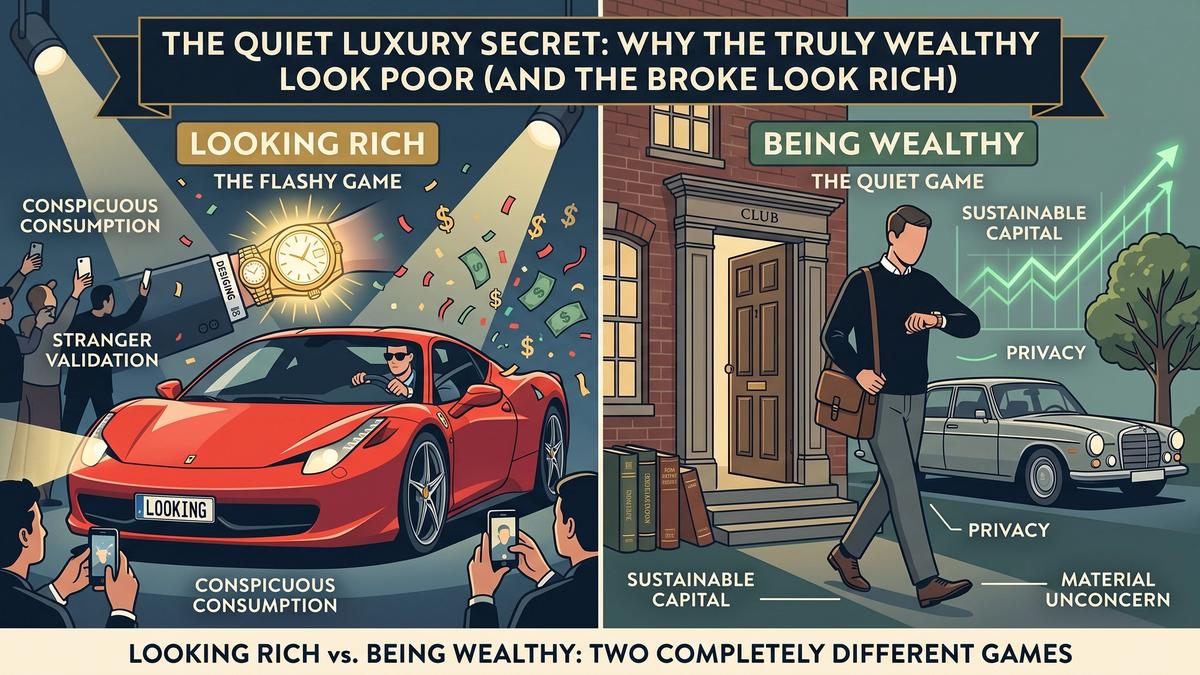
The Quiet Luxury Secret: Why the Truly Wealthy Look Poor (And the Broke Look Rich)
That $100k Ferrari doesn't prove someone's rich it proves they have $100k less. Here's why real wealth is built to stay invisible.

Earning More Than Your Family: Why Success Feels Like Betrayal
Why does hitting a financial milestone feel like betrayal instead of victory? Your attachment system may be reading success as a threat to belonging.
Why a $47 Bill Can Panic a Six-Figure Earner: Unpacking Financial Flashpoints
Your salary says you're safe. Your nervous system disagrees. Here's why a small bill can trigger full-blown panic and how to trace it back