Intelligence doesn't protect you from being poor. Here are 3 hidden mental traps keeping smart people broke and how the wealthy escape them.
How Your Brain Is Secretly Keeping You Poor
You read the personal finance books. You follow the markets. You've watched the YouTube videos, listened to the podcasts, maybe even built a budget spreadsheet you opened twice. On paper, you understand money better than most people around you.
And yet, somehow, you're still broke.
Here's the uncomfortable truth nobody tells you in those books: intelligence doesn't protect you from being poor. Financial literacy and financial behavior are two completely different things, and most of us have far more of the first than the second. In fact, your own brain the same brain you're proud of might be quietly sabotaging your wealth every single day, in ways so subtle you'd never catch them without looking closely.
This isn't about willpower, and it isn't about needing a better spreadsheet. It's about three specific mental traps, rooted in basic human psychology, that keep smart and capable people stuck financially for years. Once you can see them, they lose most of their power. Here's how they work, and how wealthy people consistently sidestep them.
Trap 1: Thinking Fast
Psychologist Daniel Kahneman popularized the idea that the brain runs on two systems. System 1 is fast, automatic, and emotional it reacts before you've even had a chance to think. System 2 is slow, deliberate, and logical, but it takes real mental effort to switch on, which is exactly why most of us don't bother.
Here's the problem: nearly every impulsive financial decision you've ever made was a System 1 decision wearing a System 2 disguise. You see a new car, a flashy watch, a limited drop of sneakers, and your brain floods with the anticipation of dopamine before you've processed a single fact about your budget. That craving doesn't care what's in your bank account. It just wants the hit, right now. So you justify the purchase on the spot "I've earned this," "I'll make it back next month," "it's basically an investment" feel good for about five minutes, and deal with the financial consequences for the next five months.
The unsettling part is that this isn't a flaw unique to people who are bad with money. It's a universal feature of how the human brain is wired. Evolution built us to prioritize immediate reward over long-term planning, because for most of human history, "long-term" wasn't guaranteed. The issue is that this ancient wiring is now aimed at a world full of one-click checkouts and 24-month financing plans.
So how do wealthy people get around a bias that's baked into the brain itself? Not through superhuman self-control through structure. One of the simplest and most effective tools is the 48-hour rule: before any non-essential purchase above a certain amount, you wait two full days before buying it. No exceptions, no rationalizing your way around it.
What's interesting is what happens during those 48 hours. You're not white knuckling your way through willpower the entire time. You're simply giving System 2 enough time to catch up and actually participate in the decision. Most of the time, the emotional urgency fades on its own. If it's still there after two days, you buy it and you buy it knowing it was a considered decision, not an impulsive one. If it's gone, you just avoided a purchase that had nothing to do with logic and everything to do with a five-minute dopamine spike.
Trap 2: Playing the Wrong Game
Here's a distinction almost nobody makes explicitly, even though it quietly wrecks a lot of financial decisions: a day trader and a retirement investor should never be taking the same advice. They are playing two entirely different games different timelines, different risk tolerances, different definitions of success, different rules for what counts as a "win." Advice that's perfectly rational for one is reckless for the other.
The trouble is, most people never stop to ask which game they're actually playing before taking action. Instead, the brain defaults to something psychologists call social herding the instinct to copy the behavior of the people around us, especially when we're uncertain. You see a neighbor bragging about the money they made in crypto, or a coworker showing off a stock pick that tripled, and something in your brain quietly concludes: if it worked for them, it'll work for me too.
What that instinct conveniently skips over is why it worked for them, if it worked at all. Maybe your neighbor has a ten-year investment horizon and can stomach a 70% drawdown without flinching. Maybe they got lucky on timing. Maybe they're not telling you about the three other trades that went badly. When you copy the outcome without understanding the game they were actually playing, you inherit all of their risk and none of their reasoning.
Wealthy people tend to opt out of this comparison trap almost entirely. They define their own game early: their own risk tolerance, their own timeline, their own criteria for a good decision and then they stick to that script regardless of what anyone else around them is doing. It's not that they're oblivious to other people getting rich faster. It's that they've made peace with the fact that someone, somewhere, is always going to be winning a different game than the one they chose to play. Chasing that comparison is how people end up making decisions that fit someone else's life instead of their own.
Trap 3: The Wealth Illusion
This is the most dangerous trap of the three, because it's built entirely on what you can see and what you can see is almost always misleading.
When you watch someone pull up in a hundred-thousand-dollar car, your brain runs an automatic calculation and concludes: that person is rich. But the only thing you actually know for certain, with real confidence, is that they have a hundred thousand dollars less than they used to. You have no idea what their savings look like, what debt they're carrying, or what trade-offs they made to drive that particular car.
This is the core of what researchers and writers on personal finance sometimes call the wealth illusion: being rich, in the visible, spend-it-loud sense, and being wealthy, in the actual net-worth sense, are frequently working against each other rather than together. Visible spending is loud by design that's the entire point of a status purchase, to be seen. Real wealth tends to be the opposite. It's quiet, boring, and often invisible to everyone except the person building it.
Wealth isn't the car in the driveway. It's the car that never got upgraded, even though it easily could have been. It's the kitchen renovation that got postponed indefinitely, not out of necessity but out of choice. It's the lifestyle inflation that simply never happened, even as the income kept climbing. Real wealth is options the ability to walk away from a job that's no longer worth it, to cover an emergency without a moment of panic, to retire on your own terms instead of someone else's schedule. None of that is visible from the outside. None of it makes for an impressive photo.
Spending money in order to look rich and actually becoming wealthy are frequently, quietly, in direct competition for the exact same dollars.
The Real Fix Isn't More Intelligence
If you've made it this far already knowing all three of these traps intellectually and still finding yourself stuck, that's the point. Knowing about a bias and being immune to it are two very different things that's precisely why smart people fall for these traps just as often as anyone else, sometimes more, because intelligence can be very good at constructing convincing justifications after the emotional decision has already been made.
Your brain, left on autopilot, will always default to immediate comfort. That's not a character flaw, and it's not something you need to feel embarrassed about it's simply how System 1 is wired, in every human brain, including the brains of people who are excellent with money. The difference isn't that wealthy people don't feel the pull toward comfort. It's that they've built small, repeatable systems that give their slower, more rational thinking a fair chance to weigh in before the money is already spent.
None of the fixes here require becoming smarter, reading more books, or finding some secret piece of financial knowledge nobody else has. They require awareness catching the exact moment your brain is about to make a fast, emotional, comfort-seeking decision, and building just enough friction to let logic catch up.
That two-day pause before an impulse buy. That refusal to copy a neighbor's trade without understanding their game. That decision to skip the upgrade that nobody else will ever notice you didn't buy. These aren't dramatic, headline-worthy moves. They're small, unglamorous, repeatable choices and they're what quietly separates the people who actually build wealth over time from the people who simply look like they have it.
Your brain isn't broken. It's just running software that was designed for a very different environment than the one you're spending money in today. The good news is that once you can see the trap clearly, you don't have to outsmart your brain you just have to build one small habit that gives it a moment to catch up.
About the writer

Writer
Alice is a Senior Financial Actuary for EveryTuesdays.com. She covers personal finance optimization, statistical market analysis, and data-driven strategies for long-term investing
You May Also Like
Browse All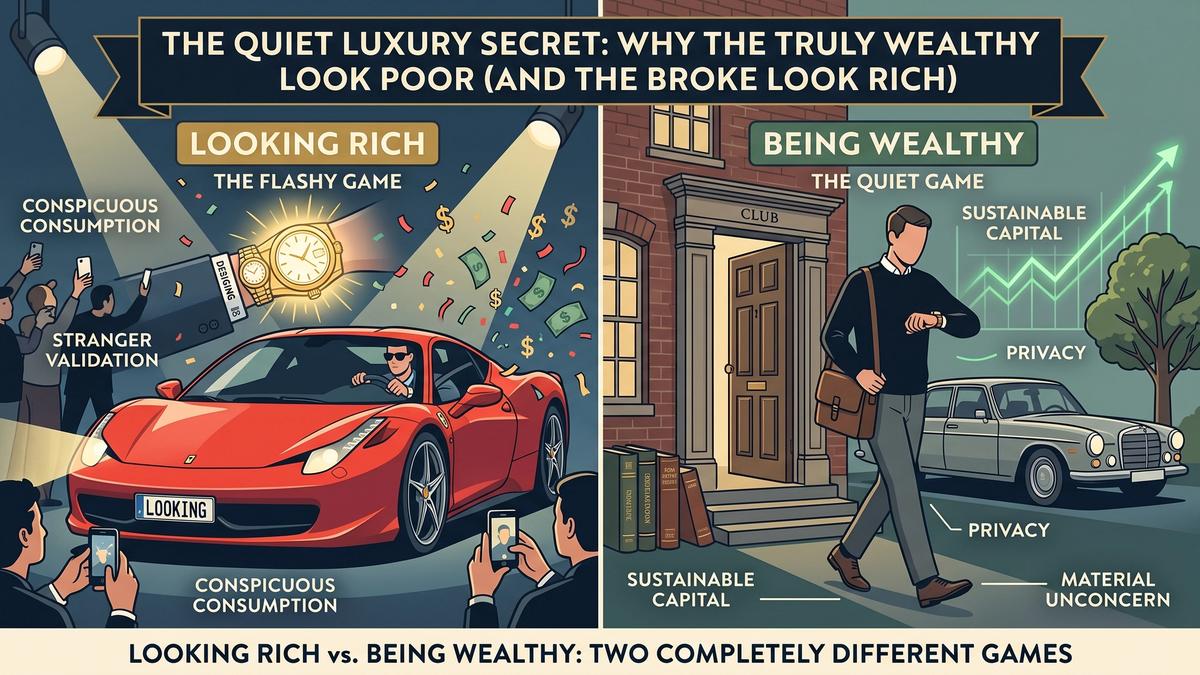
The Quiet Luxury Secret: Why the Truly Wealthy Look Poor (And the Broke Look Rich)
That $100k Ferrari doesn't prove someone's rich it proves they have $100k less. Here's why real wealth is built to stay invisible.

Earning More Than Your Family: Why Success Feels Like Betrayal
Why does hitting a financial milestone feel like betrayal instead of victory? Your attachment system may be reading success as a threat to belonging.
Why a $47 Bill Can Panic a Six-Figure Earner: Unpacking Financial Flashpoints
Your salary says you're safe. Your nervous system disagrees. Here's why a small bill can trigger full-blown panic and how to trace it back